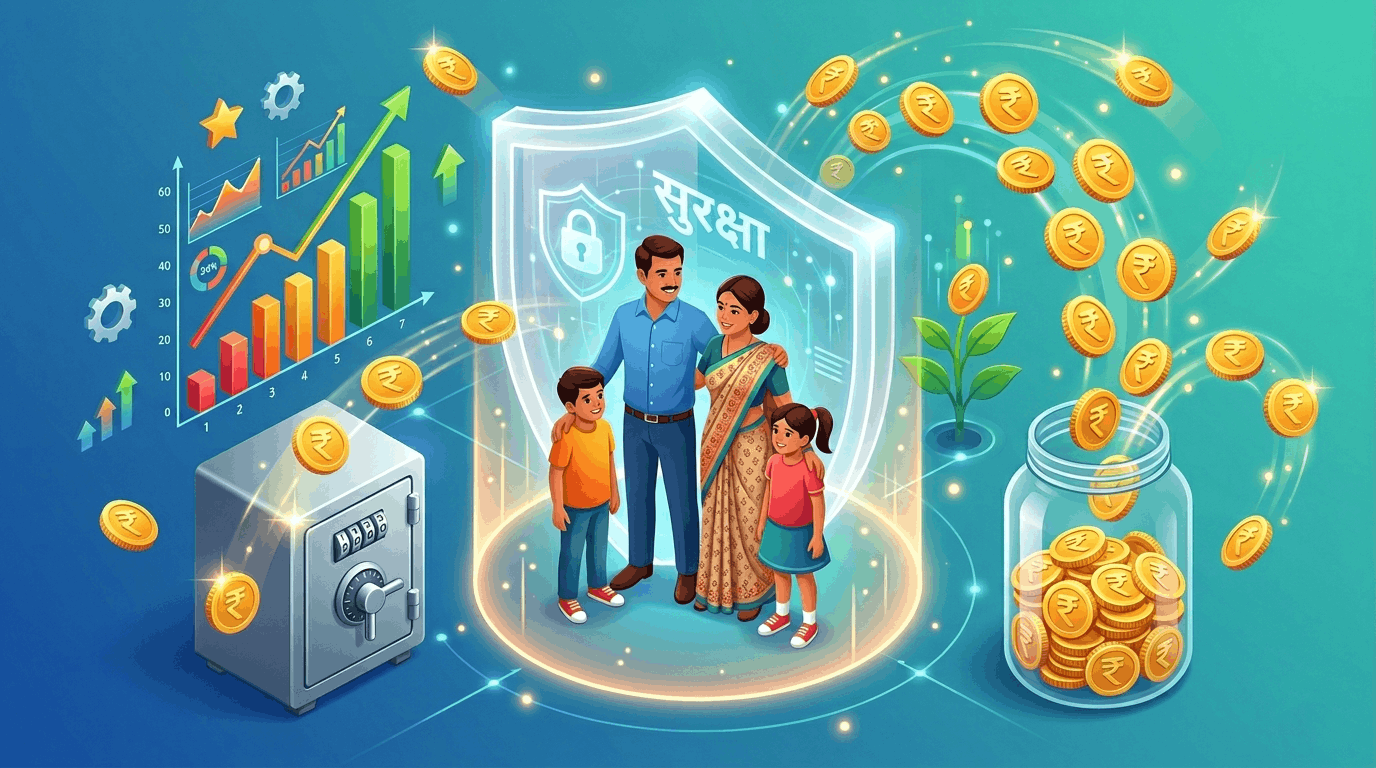
Term Insurance Plans in India (2026): A Complete Buying Guide for Beginners
Term Insurance Plans in India (2026): A Complete Buying Guide for Beginners
erm Insurance Plans in India (2026): A Complete Buying Guide for Beginners
Imagine you are the primary breadwinner of your family. Your monthly income pays the home loan EMIs, funds your children’s school fees, covers daily groceries, and fuels your family’s future dreams. Now, ask yourself a difficult but necessary question: What happens to all of this if you are no longer around tomorrow?
It is an uncomfortable thought, but ignoring it won’t change reality. This is exactly where Term Insurance comes into the picture.
Unlike complicated investment-cum-insurance schemes that promise returns but offer tiny life covers, a pure term insurance plan does one job perfectly—it replaces your income financially if life takes an unexpected turn. In 2026, with shifting economic realities and rising lifestyles, securing a robust term plan is the absolute first step of financial planning.
If you are a beginner looking to buy your very first policy, this guide will cut through the insurance jargon and tell you exactly what you need to look for.
What Exactly is Pure Term Insurance?
The simplest way to understand term insurance is to look at your car or bike insurance. You pay a small premium every year. If your vehicle gets damaged, the company pays for it. If nothing happens, you get no money back at the end of the year.
Pure term insurance works on the exact same principle, but for your life:
You pay a fixed, affordable premium every year for a specific period (say, up to age 60).
If you pass away during this period, your nominee (family) receives a massive lump sum amount (the Sum Insured), which helps them sustain their lives.
If you survive the term, the policy ends, and no maturity benefit is paid out.
Because there is no investment element attached to it, the premiums are incredibly cheap. A 25-year-old can easily secure a ₹1 Crore life cover for as low as ₹800 to ₹1,000 a month. You can never get this level of financial protection from any traditional money-back or endowment policy.
4 Crucial Metrics Beginners Must Check Before Buying
When you begin comparing term plans in India on various web portals, you will be bombarded with different percentages and features. To make an informed decision, always look closely at these four core pillars:
1. Claim Settlement Ratio (CSR)
This is the percentage of total claims an insurance company successfully pays out in a financial year compared to the claims it receives. Always look for a company with a CSR consistently above 97% to 99% over the last three to four years. This gives your family a statistical peace of mind that their claim won’t be unjustly rejected.
2. Amount Settlement Ratio (ASR)
While CSR tells you how many claims were settled, ASR tells you the value of the money settled. If a company approves 99 small claims of ₹2 Lakhs but rejects 1 big claim of ₹2 Crores, its CSR will still look amazing, but its ASR will drop. Look for an ASR above 95% to ensure they reliably pay out high-value death benefits.
3. Claim Repudiation Rate
This is the exact opposite of the settlement ratio—it tells you the percentage of claims the company rejected. Ideally, you want this number to be under 1% or as close to zero as possible.
4. Critical Riders to Enhance Your Cover
A basic term plan only pays out upon death. However, you can supercharge your policy by adding important riders for a minor bump in your premium:
Waiver of Premium Rider: If you suffer a critical illness or a permanent disability that stops you from working, all your future premiums are completely waived off, but your life cover continues intact.
Accidental Death Benefit Rider: Pays an additional lump sum amount over and above the base sum insured if the death happens due to an accident.
Avoid These 3 Common Mistakes Made by Beginners
1. Waiting “Until You Are Older”
The single biggest asset in term insurance is your current age. Insurers calculate premiums based on your health and mortality risk. When you are 25 and healthy, your premium is locked at an incredibly low rate for the rest of your life. If you wait until you are 35 or 40, your premium can easily double or triple, and any newly developed health conditions could make getting a policy difficult.
2. Hiding Medical and Lifestyle Habits
Many people hide their smoking habits, drinking frequencies, or family medical histories to save a few hundred rupees on their monthly premiums. This is a financial disaster waiting to happen. Insurance companies investigate death claims rigorously. If they discover you hid a pre-existing condition or lied about smoking, they will reject the claim instantly, leaving your family completely stranded. Always be 100% honest.
3. Opting for the “Return of Premium” (TROP) Trap
Many beginners feel uncomfortable with the idea of getting “nothing back” if they survive the policy, so they opt for a Return of Premium (TROP) plan. In a TROP plan, the insurer promises to give back all your premiums if you survive the term. However, the catch is that TROP premiums are nearly double or triple the cost of a pure term plan. It is always financially wiser to buy a pure term plan and invest the money you save into an index fund or mutual fund.
Step-by-Step: How to Choose Your Plan
Calculate Your Cover: A reliable rule of thumb is the 10X to 15X rule. Your life cover should be at least 10 to 15 times your annual income, plus any outstanding large liabilities like a home loan or education loan.
Choose Policy Term Wisely: Only take a cover up to your expected retirement age (usually 60 or 65 years). There is no logical point in paying extra premiums to cover yourself up to age 85 or 100 because, by that age, your kids will be independent, your loans will be paid off, and your active income will have ceased.
Compare and Buy Direct: Use online aggregators to compare top companies like HDFC Life, Max Life, ICICI Prudential, and Tata AIA. Once decided, try to buy directly from their official website to eliminate any agent commission structures.
Conclusion
Buying a term insurance plan is not an investment to make you rich; it is a safety net to ensure your family never becomes poor in your absence. It is the ultimate act of love and financial responsibility toward the people who depend on you.